Friday, March 25, 2011

Healthy Habits

Dear Families,

This week we have been studying healthy habits in the Owls’ Classroom. We have focused on teaching the children how their bodies work, and how their choices affect their bodies.


We began our unit of study with a fun activity that taught the children why it is important to wash our hands. First, we all put lotion on our hands. Then, Morah Larissa pretended to sneeze, and slipped her hand into a tray of glitter. We pretended that the glitter was germs! The children learned that we cannot see real germs, but that they are real. Morah Larissa shook a child’s hand, and then we all shook hands. The children were able to see how germs spread through hand to hand contact.


Then we washed the glitter off our hands. We talked about how hard it was to get the pretend germs off of our hands, and reminded the children that at school, we need to wash our hands for a long time – long enough to sing the “ABCs” or “Twinkle, Twinkle, Little Star.”


A favorite book this week was Body Battles, by Rita Golden Gelman. The children enjoyed learning about how the body protects itself from bacteria and viruses. We learned about various parts (or superheroes) of the body’s defense system, including the skin, stomach acid and white blood cells. The children were fascinated about how their bodies “fight” germs. On the playground, a new favorite game has become “germs” and “good guys.”


We deepened our study of germs and our immune systems with a visit from Kylan’s mother, Kristi Guinn. She talked to the children about her work as a scientist, Kristi read the children I Know How We Fight Germs, by Kate Rowan. They had many thoughtful questions for her. Thank you so much, Kristi!
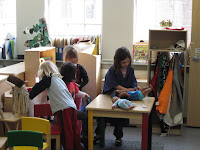

We have introduced a doctor’s kit, some scrubs and even a real stethoscope into our dramatic play area. These new materials have invigorated the children’s interest in dramatic play. They enjoy pretending that they work at “Framingham Hospital” (thanks to our Framingham residents, Ashley and Julia). They are fascinated by the real stethoscope and finding their own heart beats. There has been a rash of cardiac arrest among the doll population of our classroom, the cure to which appears to be some fresh squeezed tomato juice!


Pretend play is crucial to the social and emotional development of four- and five-year-olds as they learn to negotiate with other children, to take turns leading and following other children and to share materials.


We have also enjoyed using some traditional medical supplies in unusual ways this week. We used q-tips to paint with liquid watercolors at the art table and used tweezers to move cotton balls into egg cartons. Both of these sensory experiences (the small thin q-tips and the challenging tweezers) build children’s hand strength.


We also introduced some concepts about nutrition this week. The children enjoyed looking at grocery ads at the Writing Center and practiced copying some of the text from these ads. Because grocery ads contain pictures of the foods with labels, they are a wonderful way for children to engage in writing while making meaning from text at the same time. The children also enjoyed using word cards to write about their favorite foods – and they even tried writing lower case letters.


At Morning Meeting on Wednesday, we pretended to take a field trip to the grocery store. The children pretended to go shopping and picked out a photograph of a food. We sorted our “purchases” into 3 shopping bags, one labeled “Always,” one labeled “Sometimes,” and one labeled “Just a Little Bit.” The children learned that “Always” foods are foods that we can always choose to eat, because they fill us up and give our bodies energy, help our muscles, or make our bones stronger. We put photographs of green beans, yogurt, milk, and whole-grain crackers into the “Always” bag. We learned that some foods help our bodies grow and get stronger, but they might have things like fat or sugar in them that are not good for our bodies if we eat too much. We put those foods (like pizza and sugar-filled cereals) into the “Sometimes” bag. Finally, we found some foods that taste good, but do not help our bodies grow or get stronger! We put those foods (such as chocolate and candy) into the “Just a Little Bit” bag. We talked about how we eat “Just a Little Bit” of these foods. Then the children created their own collages, using cut-out pictures of food. They sorted their choices into boxes labeled “Always,” “Sometimes,” and “Just a Little Bit.”


The children also were each invited to join Morah Larissa at the computer, where we looked at a nutrition website aimed at preschoolers from the federal government. On the preschool section of http://www.mypyramid.gov/, the children were able to type in their names, click on their age and then print out their own personalized food pyramid! We talked about how the food pyramid helps us decide what kinds and how much food to eat. This was a meaningful way for the children to interact with technology to gain information. In addition, these are some of the resources that we have used at school to coach children through meal times.


While we have had a special focus on healthy habits this week, we discussed concepts of personal hygiene (such as brushing teeth and washing hands) as well as healthy eating habits throughout each and every day at school. This week has allowed us to explicitly focus on some of the language and ideas that we discuss at snack time, lunch time and every time we enter the room and wash our hands!


Shabbat Shalom,

Morah Larissa and Morah Kate

Friday, March 18, 2011

Celebrate Good Times, Come On!

Dear Families,

This has been a week of many celebrations in the Owls’ Room! On Tuesday, we completed our alphabet chart. This was a great achievement for the children and we celebrated with some alphabet cookies for snack. The children’s enthusiasm for this project was incredible and they have each demonstrated a new sense of mastery over alphabet letters. They often look at the alphabet chart throughout the day, and refer to it when experimenting with writing. We are looking forward to putting the photos of the children into a small book! Please stay tuned for more information about this.


We also enjoyed making Morah Shari a small gift for her birthday on Thursday. We decorated a tote bag for her and made it extra sparkly, as per the children’s request. It is always an amusing challenge for four- and five-year-olds to try to keep a secret about a gift. We may have had more security leaks than we would like to admit! The children felt a great sense of pride about being able to create something real and useful for a favorite teacher.

We led up to our Purim festivities on Friday by wearing funny hats on Wednesday and celebrating Backwards Day on Thursday. We even tried walking backwards and ate lunch before snack on Backwards Day!

Finally, we spent much of our week continuing to learn about Purim and preparing to celebrate it. The children watched Morah Kate and Morah Larissa re-create the Purim story using puppets, and then made their own puppets. We took out the puppet theater at Dramatic Play so that the children could perform their own puppet shows. Through so many varied, but repeated exposures to the Purim story, the children have been able to develop an understanding of why we celebrate this holiday.


We focused many of our discussions this week on some of the feelings that the characters of the Purim story might have had. In particular, we have talked about Esther’s bravery – how it was scary for her to go before King Achashverosh, but how brave she was nonetheless. One day at Circle Time, the children discussed scary situations in which they have been brave, and the next day, they drew and used dictation to write about their own experiences. The children thought about times that they have jumped off diving boards or been at a doctor’s office. Talking about the feelings characters might have in stories helps children to build their comprehension skills. It also helps children to relate to the story and makes the learning more relevant for the children.


We also prepared for Purim this week by decorating bags for Mishloach Manot, or the gifts of food that we give on Purim. Most importantly, we made hamantaschen! First we read a teacher-made “book” of the recipe. Then we made the dough, carefully measuring the flour, sugar, oil and eggs. We refrigerated the dough overnight and shaped the hamantaschen the next day. This was a great geometry lesson, as we learned how to turn a circle into a triangle shaped cookie.


The theme of castles appears in the Purim story (as Esther goes to live in the king’s castle) and is often of high interest to young children. Morah Larissa’s husband, Dr. Gregory Halfond, who is a Medieval Historian, joined us on Thursday to read the children a book about castles. The children were fascinated by the pictures. They discussed the sequence of events that they have learned about. Julia pointed out that first there were dinosaurs, then Queen Esther and then came our school. The historian-in-residence agreed that this was a fairly good assessment of things.


Finally, we made masks for Purim as well, decorating paper cut-outs with water colors. Another favorite Purim activity used laminated paper hamantaschen for sorting, counting and making patterns. The children’s math skills have all grown so much throughout the year!


Please remember that there is no school next Thursday, March 24th as the TCEE staff will be participating in a Professional Development Day at Smith College.


Shabbat Shalom and Happy Purim!

-Morah Kate and Morah Larissa

Thursday, March 10, 2011

Purim, Freeze Clean-up and Mat Man!

Dear Families,

We have enjoyed our study of Purim this week. The concepts that we focused on are learning that Purim is a fun holiday and that we celebrate it by dressing up. We have also focused on learning the story of Esther. To that end, we have read several versions of the Purim story. We have even begun to act it out, dressing up as King Ahashueros, Queen Vashti, Mordecai, Queen Esther, and even Haman! It was fun to use our dress up clothes to make a story come alive as Morah Larissa read the book. Doing a “play” while a book is read supports children’s comprehension of the story.


The children have been very curious about the characters in the Purim story. It is fascinating for them to hear about Queens and Kings and brave “superheroes” like Esther and Mordecai. At the art table on Wednesday, we made crowns so that the children could pretend to be Queen Esther or King Ahashueros.


We have also been working hard building castles (such as the one Queen Esther might have lived in) at the block area. On Tuesday, at Morning Meeting, Morah Larissa demonstrated to the children how to use drawing to create a simple plan (or a blueprint) for a castle to build at the Block Area. First, the children contributed their ideas for the castle while Morah Larissa drew them. This was a great way to build mathematical vocabulary surrounding the unit blocks, and to build spatial awareness. Next, we built our castle together! The children learned how to translate a 2-dimensional plan into 3 dimensions. It was also a wonderful opportunity for the children to work cooperatively on a block building with teacher support.


We have also had a lot of fun making groggers, or noisemakers, this week. Traditionally, groggers are used to make noise when Haman’s name is read during the Megillah (or Book of Esther) reading on Purim. We made two different kinds of groggers this week: one made with salt in a sealed toilet paper tube, and one made with beans in a stapled-closed paper plate. On Friday, we will compare the sounds of our different groggers. This will be a fun science exploration and build the children’s sensory vocabulary. Meanwhile, a new favorite game for the children is to ask Morah Kate to say a list of names. When she says “Haman,” they shake their groggers!


The children have also experimented with some real groggers. On Wednesday, we played “Esther, Esther, Where’s That Grogger?” The children took turns pretending to be “Esther,” and hid in various places in the room. When the rest of the group shouted, “Esther, Esther, where’s that grogger?” we tried to use our sense of hearing to find the our missing friend with the grogger!


Another new fun game this week has been “Freeze Clean-up.” We put on a song during clean-up time, and the children clean up to the music. Just like in “Freeze Dance,” they have to freeze if we pause the music. This has really changed the tune of everyone’s least favorite time of the day! Sometimes adding in a fun game can engage children in routines that are important but otherwise not enjoyable for them.


We also learned a new fun song this week, “Mat Man. This song and activity are part of the Handwriting Without Tears curriculum, which is used in the Brookline Public Schools in kindergarten. The vocabulary and routines that the children are learning in the Owls room this year will be consistent with what is used in the kindergarten classes. “Mat Man” is an image of a person created using the wood blocks that we have used when learning letters. (The blocks are various lines and curves that are put together to make letters, and each has a specific name that the children are learning.) The Mat Man song teaches the children about each different part of the body, and it builds body awareness as well as number sense. It is also a great way to teach the children how to draw more detailed illustrations of people. The children have had much fun drawing Mat Man!


Shabbat Shalom,

Morah Larissa and Morah Kate

Friday, March 4, 2011

Welcome Kylan, Amanut and "We Are the Dinosaurs!"

Dear Families,

We have been delighted to welcome Kylan Guinn and his family to the Owls class! We are all so excited to get to know them. The Owls have enjoyed finding their new cubby spaces, as we moved things around a bit to accommodate the addition to our community.

On Tuesday this week, we happily explored the new Amanut, or Art Studio, at the Trust Center. This new space has been carefully set up to nurture the children’s explorations of process-based art. It is fun for the children to do crafts in the classroom, and we often teach important content and skills this way. However, young children benefit greatly from the opportunity to create and express their own ideas freely with variable mediums. On Tuesday, we experimented with crayons at the easel. The children also used a large piece of butcher paper taped to the floor to create a large collaborative mural. It was wonderful to find Shayna and Noah working together to carefully illustrate and label some of their favorite characters from Toy Story 3. Many of the children also explored the collage bank. Matthew and Nicholas discovered two different ways to make birds. Matthew used feathers while Nicholas used popsicle sticks!
On Thursday, we welcomed Rhonda Solomon, a Guest Reader from the Temple Ohabei Shalom Sisterhood. She brought two Purim books to read to the children: It’s Purim Time! By Latifa Berry Kropf, and When It’s Purim, by Edie Stoltz Zolkower, and donated them to our growing TCEE collection. Mrs. Solomon also brought us hamantaschen to taste at snack time. It was a delight to get to know her, and we happily wished her “todah rabah,” or thank you very much.

We continued our study of dinosaurs this week, focusing on learning about some of our favorite species. We have learned that some dinosaurs were plant-eaters and that others were meat-eaters. We have also noticed the different ways that different species of dinosaurs moved – either on two feet or on four feet. We had a lot of fun moving around like dinosaurs during the indoor movement time afforded to us by some of the rainy and very cold days this week. The children took turns choosing various pictures of dinosaurs, and then finding ways to move their bodies like them. It is hard for us to move around on four feet, like stegosaurus or triceratops, but a great opportunity for the children to develop their core strength.


Another highlight of the week was pretending to be paleontologists, excavating toy dinosaurs out of the ice cubes in which Morah Larissa and Morah Kate froze them. The children used eye-droppers to melt their ice cubes and free their dinosaurs. This was a lot of fun, but also a great way to teach science concepts (such as paleontology, excavation, fossils, as well as ice/water and melting) while building children’s fine motor strength. Small eye-droppers are a great way to build the hand strength necessary for children to become writers.


We have also been enjoying a new favorite song: “We are the Dinosaurs,” by The Laurie Berkner Band (click on the video to hear the song). We love marching around the room pretending to be dinosaurs! In addition, the children have loved playing with the nest that they made before vacation. They take turns pretending to be baby dinosaurs hatching from eggs, or adult dinosaurs sitting on a nest. On Friday this week, we will read a book from Jane Yolen’s popular series about dinosaurs, How Do Dinosaurs Eat Their Food? Then, we will write our own book, titled, How Do Dinosaurs Celebrate Shabbat?


This week, we have focused on some of the literacy and mathematical skills that support children in collecting and organizing information. We have talked about what kind of words we use in a question. The children have learned that questions are words we use to talk about things that we wonder about, and things that we don’t know yet. The children have each practiced asking a question before reading non-fiction books about dinosaurs. It is fun to find the answers inside our books!


We have also introduced Venn Diagrams this week. We used hula hoops to make a Venn diagram with our bodies, and we discovered who has brothers, sisters, both, or none. We also created a Venn diagram with our toy dinosaurs, and compared and contrasted the ways that they move.


Finally, we have continued to build on our graphing skills this week. The children have learned that a graph is a chart that we can use to find out how many people like or do not like something. We created a graph about our favorite dinosaurs. Stegosaurus and iguanodon were two favorites! Finally, we also used graph paper with some of our manipulative toys, to compare and contrast them by various attributes including color and shape.


Shabbat Shalom,

Morah Larissa and Morah Kate

Saturday, February 19, 2011

Dinosaurs Everywhere!

Dear Families,

We have had so much fun exploring dinosaurs this week in the Owl Room! This unit was sparked by the children’s enthusiasm for the dinosaur books and materials in the classroom that were used in the Science Giants enrichment class on Mondays this past session. This is an excellent example of our use of emergent curriculum practices at the Trust Center! We try to incorporate the children’s existing interests and background knowledge into the curriculum whenever possible. This helps us to create a rich curriculum that is fun for the children. In addition, because young children are concrete learners, they learn best when engaging with concepts that are relevant to them. Creating units around the children’s interests ensures that the curriculum is relevant.

One concept that we focused on this week was that dinosaurs lived a very, very long time ago and are now extinct. We also focused on learning how very big the dinosaurs were!

Books have been integral to our teaching about dinosaurs. Morah Larissa participates in the Teacher Partner Program at the Museum of Science in Boston, which allows us to borrow books and other resources from their collection. This week we read Dinosaur Bones, by Bob Barner, T is For Terrible, by Peter McCarty, and The Dinosaur, by Anna Milbourne from this collection. Those of you who are not participating in Vacation Camp this week and looking for some fun family activities might enjoy a visit to the dinosaur exhibit at the Museum of Science, as we will continue with this unit the week following vacation.

The children enjoyed drawing their favorite dinosaurs to hang up on our bulletin board this week. We also studied the different body parts of different kinds of dinosaurs. We made some comparisons to our own bodies. We discovered some similarities and differences. For example, dinosaurs had nostrils and toes just like humans! But we certainly don’t have tails! Then we did the “Dino Pokey” (to the tune of the “Hokey Pokey”), and pretended to be dinosaurs sticking our teeth, long necks, and even tails into the circle. We also learned a fun new movement poem, and practiced moving around like different kinds of dinosaurs.

At the art table this week, we have started to build a large dinosaur nest, using recycled materials such as toilet paper tubes and newspaper. When we are done building the nest, we will paint it brown. Once it is dry, we will add it to our Dramatic Play set up so that the children can pretend to be baby dinosaurs hatching from eggs. We have read a couple of books about baby dinosaurs, and they have particularly captured the children’s imagination. Working on a large collaborative art project encourages the children to build group problem-solving skills and to learn to use language to work together. Creating a large three-dimensional project builds children’s spatial awareness.

On Thursday, we had a chance to investigate how long dinosaurs really were! Morah Larissa cut lengths of yarn to the sizes of Compsognathus, Triceratops, Stegosaurus, Tyrannosaurus Rex, and Brachiosaurus. First, we made some predictions about which dinosaurs might be able to fit in our classroom and school. We discovered the Triceratops could barely fit in our classroom! If there was a Triceratops sitting at Circle Time, its head would be out the doorway! Then, we went outside and took advantage of the nice weather to complete our investigation. The children sat on the sidewalk with Morah Kate, and took turns holding one end of a piece of yarn while Morah Larissa walked across the parking lot with the other end of each piece of yarn. When Shayna held one end of the yarn that was as long a Brachiasaurus, the children could barely see Morah Larissa all the way on the other side of the parking lot!

A new favorite song this week has been the “Dinosaur on Shabbat” song. The children have had a great time singing about the idea of a dinosaur showing up to celebrate Shabbat! We have also had a lot of fun walking around the synagogue. This is a great way to get a little exercise, as well as to gain comfort and familiarity with the various parts of our temple.

We have also had a lot of fun this week exploring measuring, using both formal and informal methods. Besides measuring how long real dinosaurs were, we also tried some measuring with toy dinosaurs. The children investigated some informal ways to measure the toy dinosaurs – they tried using their hands and even their shoes! Then we used a ruler to see how many inches each dinosaur was. Using measuring cups in the water table has been a fun way to experiment with measuring volume. We also used the measuring cups in our trays with cornmeal this week. Julia was worried that her friends had more cornmeal than her. Morah Larissa suggested that we might be able to use measuring to solve the problem. So we tried filling up one-cup sized measuring cups at each tray and discovered that, indeed, Julia needed more cornmeal. Finally, we have been using a scale to experiment with measuring and comparing the weight of various toys.

A favorite new song this week has been, “Where Do You Start Your Letters?” This catchy song is part of the Handwriting Without Tears curriculum, and reinforces the idea of remembering to start writing one’s letters at the top of the page. With the children singing the song as often as they are (often on their own!), we are confident they will begin to remember to slow down and carefully write their letters starting at the top.

Shabbat Shalom,
Morah Larissa and Morah Kate

Friday, February 18, 2011

Aleph Bet and Math Skills

Dear Families,

Thank you all so much for helping your children to select vegetables beginning with the alphabet letters that they took home. They are all so excited to make another batch of alphabet soup. The process of choosing an ingredient has been the subject of many a lunch conversation this week!

Our alphabet project (the creation of an alphabet chart on our wall) has been met with great enthusiasm this week. The children love figuring out how to arrange their bodies to make each letter of the alphabet, and they have started to think ahead and make plans for upcoming letters. This is a great way for them to start to move beyond recognition of letters and to comprehend the various types of lines that letters are composed of. The children are equally enthusiastic about decorating card-board alphabet letters to hang on our wall. They think hard each day about things that they might decorate the next day’s letter with! We are able to honor many of their ideas, which has been a wonderful way for the children to see that their plans are carried through in the classroom. Furthermore, this has deepened the children’s awareness of sound-symbol relationships.

Building on the children’s excitement about our new environmental print, we added labels to many of the toys and centers in the classroom. The labels contain both photos of the toys as well as written text. Hanging the labels in the classroom was a fun matching activity for the children. First they had to match two photo and word cards to each other, and then they had to find the related toy so that we could label it! Written labels support the children in connecting written text to meaning and also help children to organize themselves. Furthermore, an organized environment supports children in their ability to focus on their learning.

Related to our study of the English alphabet, we have done much talking about the Alef-Bet (the Hebrew alphabet). The children were particularly curious to try out an Alef-Bet puzzle this week and were curious to try to make connections between English and Hebrew letters.

Another new thing in our classroom is our science center! This is a spot for the children to experiment with science materials, such as magnets, magnifying glasses, found objects for nature, etc. in a way that is hands on. It is wonderful to nurture the children’s curiosity about the world while teaching them tools (such as observation, making predictions) to learn about the world around them.

A math skill that we have focused on this week is the concept of estimation. The children have practiced saying this new long word, and have learned that to make an estimation means to make a “thinking guess.” We have enjoyed playing with our “estimation jar.” The children look at a set of objects in the jar, and make estimates about how many might be inside. They have even begun to record their own estimates. The children have learned three steps to estimation: first they make their “thinking guess,” then they record their responses, and finally, we check our guesses. This has been a great opportunity to practice writing numerical digits. We have learned that counting is a great strategy to check our work. Learning to stop and check over work that they have done is important to developing children’s critical thinking skills, and will support them in all areas of learning throughout their years of schooling. When we estimate, we check our work by counting the objects in the estimation jar. As always, when we count at school, we remind the children to line up the objects and to then use their “magic pointer fingers” to touch and track each object as they count.

We have also begun support the children in building directionality and learning right and left in school this week by teaching them to recognize their right hands. We’ve used a multi-sensory approach to support the children in their diverse learning styles. We’ve given the children stamps, a drop of warm water, stickers, and a dot drawn with washable marker on their right hands. By over-teaching children to recognize their right hands, we automatically support the children in learning to recognize the left, as that is the only other alternative! We’ve been enjoying practicing discriminating right from left by dancing to the hokey pokey. While not all children are right-handed, teaching the right hand supports them in learning some of the special things that we do with this hand.

One of the things that the children have learned that we do with our right hands is to shake hands! We’ve started singing and dancing to a new hello song in which the children greet each other and teachers by shaking hands. They learn to look their partner in the eye, shake right hands, and say hello. While we live in a world that is increasingly casual in terms of social interactions, building eye contact and learning to politely greet someone remain essential social skills. This may be a fun skill to reinforce at home!

Shabbat Shalom,

Morah Larissa and Morah Kate

Friday, February 11, 2011

Alphabet Project

Dear Families,

Thank you all so much for helping your children to select vegetables beginning with the alphabet letters that they took home. They are all so excited to make another batch of alphabet soup. The process of choosing an ingredient has been the subject of many a lunch conversation this week!

Our alphabet project (the creation of an alphabet chart on our wall) has been met with great enthusiasm this week. The children love figuring out how to arrange their bodies to make each letter of the alphabet, and they have started to think ahead and make plans for upcoming letters. This is a great way for them to start to move beyond recognition of letters and to comprehend the various types of lines that letters are composed of. The children are equally enthusiastic about decorating card-board alphabet letters to hang on our wall. They think hard each day about things that they might decorate the next day’s letter with! We are able to honor many of their ideas, which has been a wonderful way for the children to see that their plans are carried through in the classroom. Furthermore, this has deepened the children’s awareness of sound-symbol relationships.

Building on the children’s excitement about our new environmental print, we added labels to many of the toys and centers in the classroom. The labels contain both photos of the toys as well as written text. Hanging the labels in the classroom was a fun matching activity for the children. First they had to match two photo and word cards to each other, and then they had to find the related toy so that we could label it! Written labels support the children in connecting written text to meaning and also help children to organize themselves. Furthermore, an organized environment supports children in their ability to focus on their learning.

Related to our study of the English alphabet, we have done much talking about the Alef-Bet (the Hebrew alphabet). The children were particularly curious to try out an Alef-Bet puzzle this week and were curious to try to make connections between English and Hebrew letters.

Another new thing in our classroom is our science center! This is a spot for the children to experiment with science materials, such as magnets, magnifying glasses, found objects for nature, etc. in a way that is hands on. It is wonderful to nurture the children’s curiosity about the world while teaching them tools (such as observation, making predictions) to learn about the world around them.

A math skill that we have focused on this week is the concept of estimation. The children have practiced saying this new long word, and have learned that to make an estimation means to make a “thinking guess.” We have enjoyed playing with our “estimation jar.” The children look at a set of objects in the jar, and make estimates about how many might be inside. They have even begun to record their own estimates. The children have learned three steps to estimation: first they make their “thinking guess,” then they record their responses, and finally, we check our guesses. This has been a great opportunity to practice writing numerical digits. We have learned that counting is a great strategy to check our work. Learning to stop and check over work that they have done is important to developing children’s critical thinking skills, and will support them in all areas of learning throughout their years of schooling. When we estimate, we check our work by counting the objects in the estimation jar. As always, when we count at school, we remind the children to line up the objects and to then use their “magic pointer fingers” to touch and track each object as they count.

We have also begun support the children in building directionality and learning right and left in school this week by teaching them to recognize their right hands. We’ve used a multi-sensory approach to support the children in their diverse learning styles. We’ve given the children stamps, a drop of warm water, stickers, and a dot drawn with washable marker on their right hands. By over-teaching children to recognize their right hands, we automatically support the children in learning to recognize the left, as that is the only other alternative! We’ve been enjoying practicing discriminating right from left by dancing to the hokey pokey. While not all children are right-handed, teaching the right hand supports them in learning some of the special things that we do with this hand.

One of the things that the children have learned that we do with our right hands is to shake hands! We’ve started singing and dancing to a new hello song in which the children greet each other and teachers by shaking hands. They learn to look their partner in the eye, shake right hands, and say hello. While we live in a world that is increasingly casual in terms of social interactions, building eye contact and learning to politely greet someone remain essential social skills. This may be a fun skill to reinforce at home!

Shabbat Shalom,

Morah Larissa and Morah Kate